Why Fragmented Pet Data is the Bottleneck in 2026 B2B Pet Care
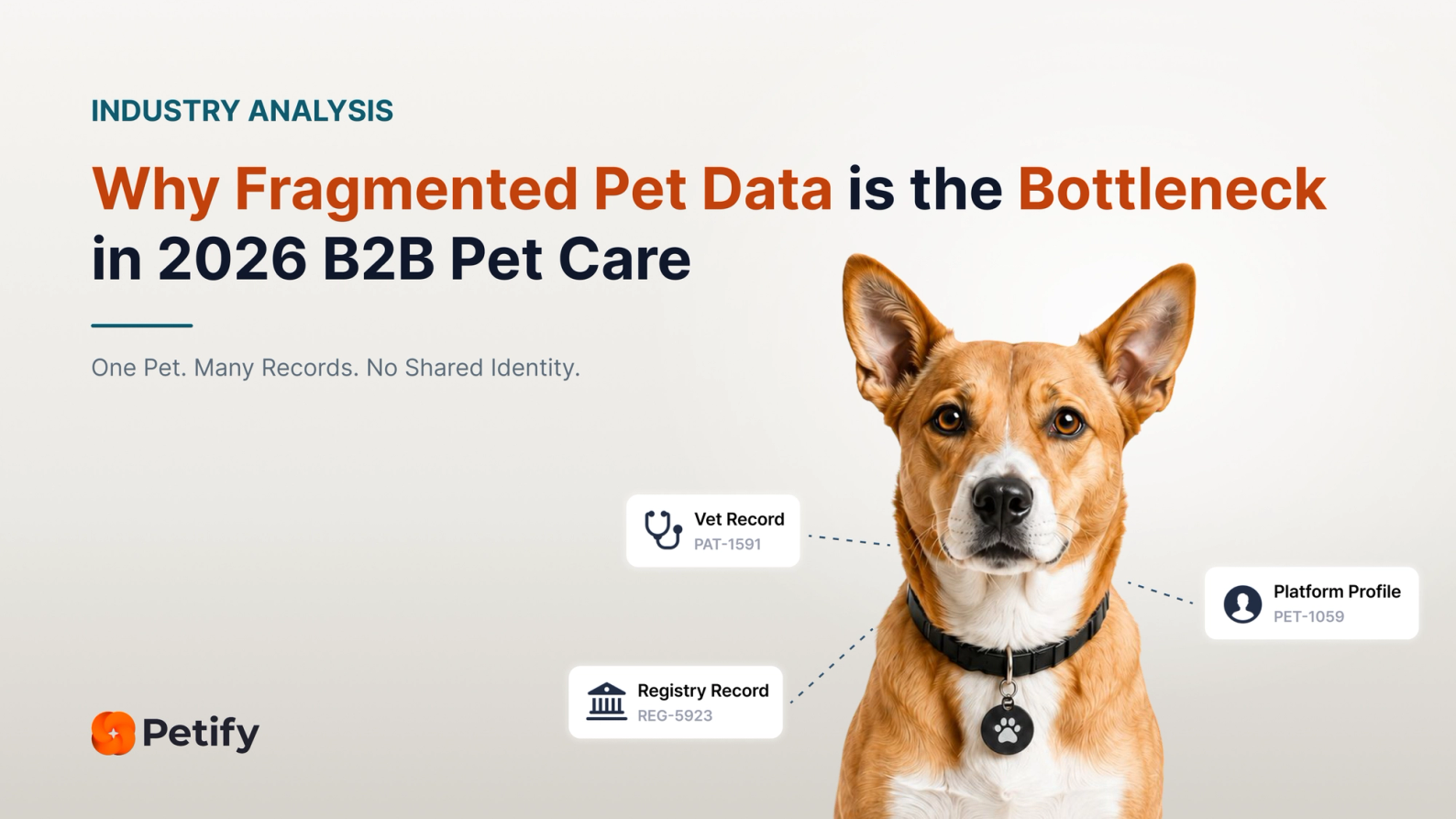
The pet industry doesn't lack data. It lacks a shared identity.
Ask a B2B operator in pet care what they're short of, and "data" won't be the answer.
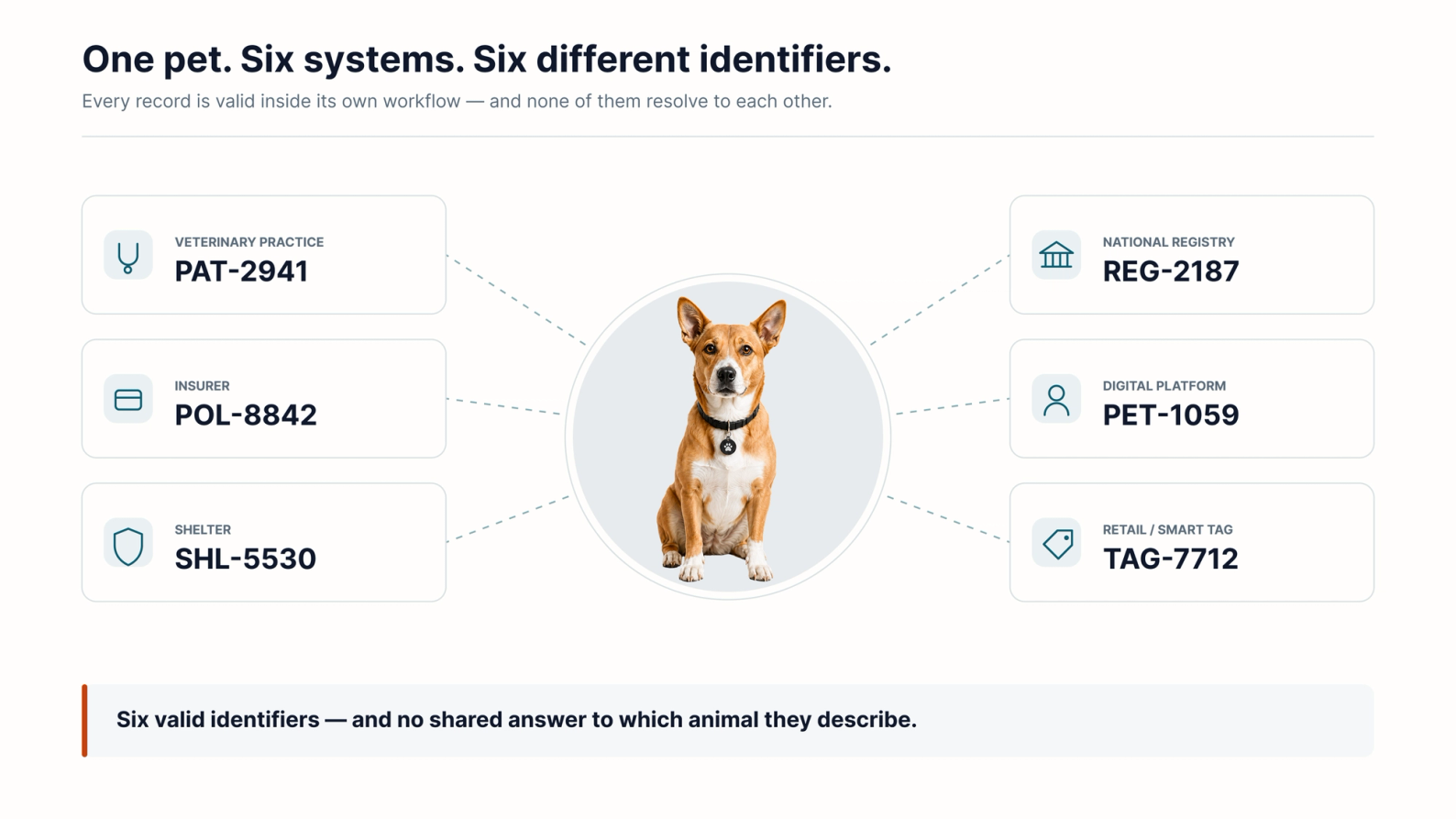
Veterinary practices generate clinical records. Insurers generate policies and claims. Shelters generate intake records. Registries maintain registration relationships. Apps generate their own pet profiles. Every one of those records is accurate and well-designed for the workflow that created it.
The bottleneck sits between them. None of those records automatically resolves to one persistent identity for the animal. Two systems can exchange data over a documented API and still be unable to answer a much simpler question: is PET-1059 in your system the same animal as PAT-2941 in mine?
That unanswered question is what quietly caps automation across 2026 B2B pet tech.
One pet, many records
Pet data became fragmented for an entirely rational reason: different sectors digitized different workflows at different times, and each one needed its own identifier.
A first vet visit creates a Patient ID. Shelter intake creates an Intake ID. An insurance purchase creates a policy-linked pet record. National registration creates a registration relationship. A platform creates a profile.
Each identifier is completely valid inside its own workflow. The gap opens the moment an organization needs to determine whether different records, profiles or IDs refer to the same real-world animal. Each system creates the identity it needs — and fragmentation appears between the systems.
The scale changed, and so did the cost
Fragmented pet records are not a new problem. What's new is the volume of records, connections and automated decisions now stacked on top of an identity layer that was never built — which is why pet data integration has quietly become one of the largest engineering line items in the sector.
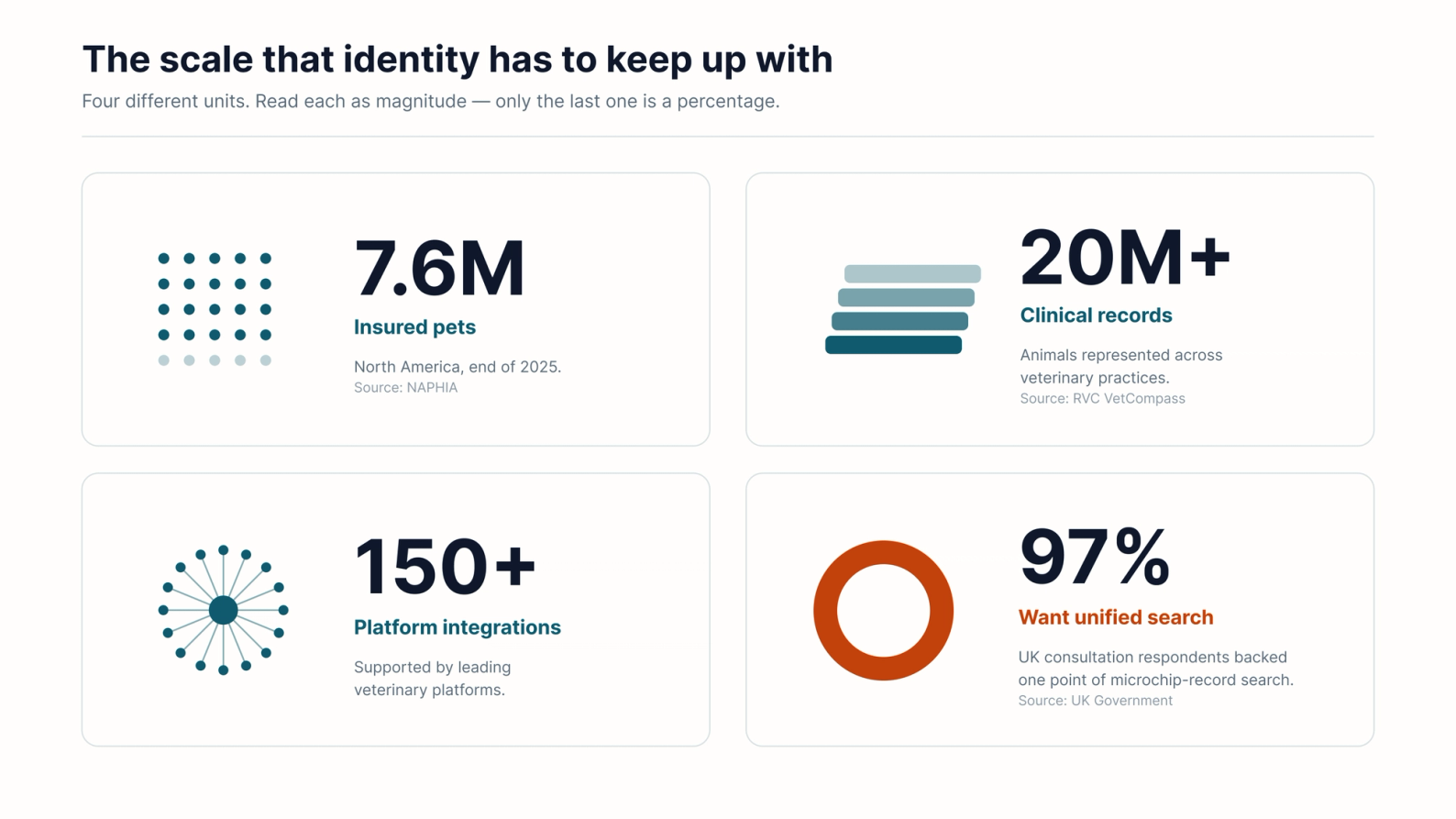
Four figures, four different units — read them as magnitude, not as one comparable scale. 7.6M is the number of insured pets in North America at the end of 2025 (NAPHIA). 20M+ is the number of animals represented in the Royal Veterinary College's VetCompass clinical dataset. 150+ reflects the integration ecosystems that leading veterinary platforms now publish. 97% is the share of UK consultation respondents who backed a single point of microchip-record search — the only true percentage in the set.
Read those four numbers together and the pattern is clear. The pet healthcare ecosystem has become highly connected at the system level while remaining inconsistent at the identity level.
And it compounds. Every new integration multiplies the record pairs that someone — or some rule engine — has to reconcile. Connectivity scales linearly; reconciliation work scales much faster, which is why pet data integration effort rarely falls even as the APIs themselves get better.
Where the cost actually lands
"Fragmented data" sounds like an architecture complaint. In a B2B operation it shows up as line items.
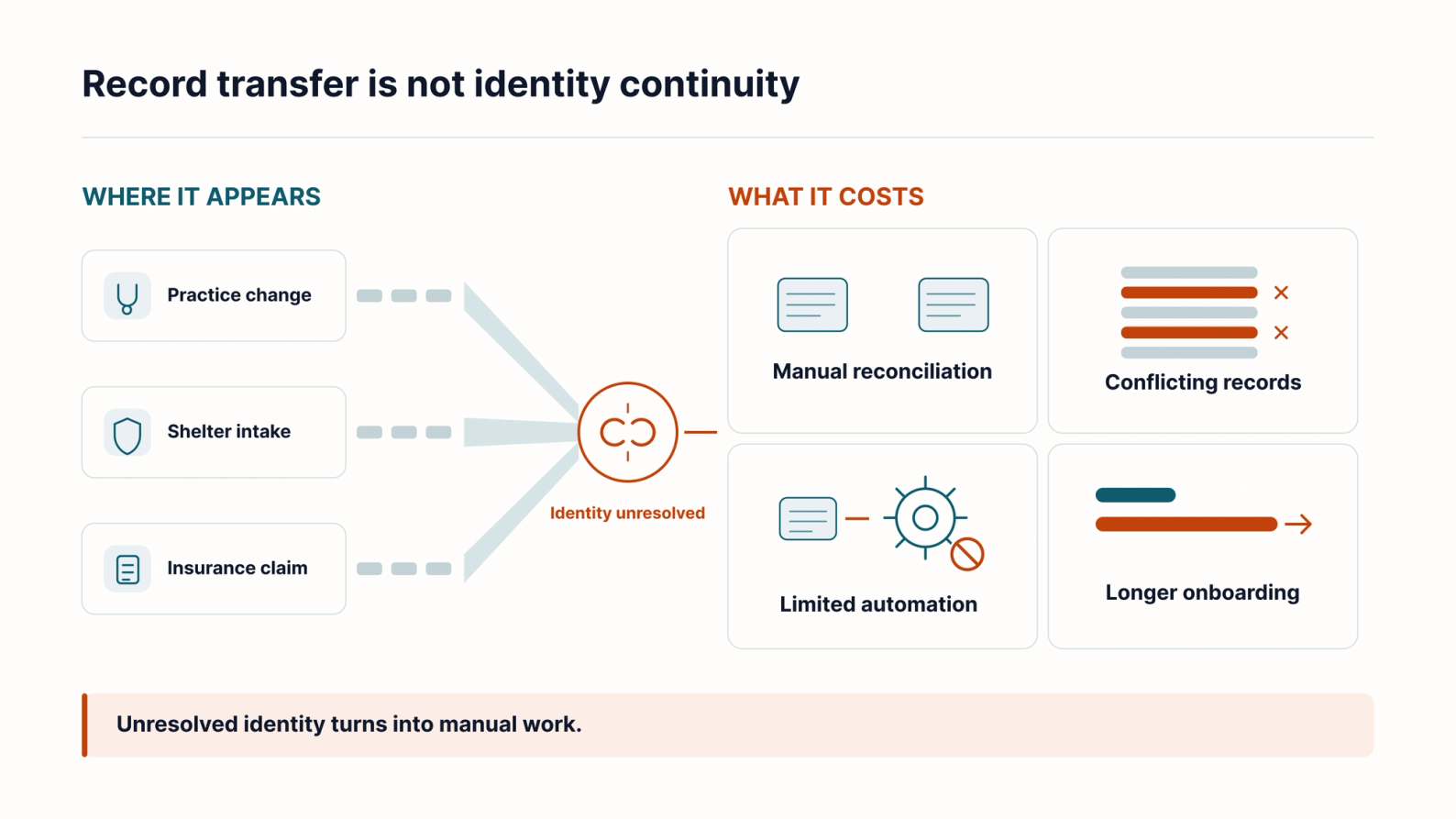
Manual reconciliation. Before a team can act on a record, someone often has to confirm which animal it belongs to — comparing Pet IDs, owner details, microchip numbers, invoices, images and medical histories by hand. It is identity resolution performed manually, one record pair at a time — skilled labour spent on a question that should answer itself.
Lower data confidence. Duplicate, incomplete or conflicting records erode trust in everything built on the data: lifecycle views, analytics, risk models, automated decisions. Teams start treating their own dashboards as directional rather than authoritative.
Limited automation. The most expensive item, and the least visible. Systems can technically exchange records and still route cases to human review, because the animal behind the records was never reliably resolved. Without automated identity resolution the integration is live while the automation rate stays flat — you pay for the pipe and keep paying for the people.
Slower integrations. Every new partnership tends to require another bespoke set of matching rules — names, owner information, microchip numbers, provider-specific Pet IDs. Onboarding time becomes a function of how many identity edge cases two teams can agree on, which directly delays revenue from new channels.
The friction concentrates in three places. In each one the record moves perfectly well while the animal behind it still has to be confirmed by a person.
A pet changes veterinary practices. An owner relocates and registers their dog at a new clinic. The practice requests history from the previous vet and receives a document bundle filed under a different Patient ID. Before any of it is usable, a nurse compares the microchip number, date of birth and vaccination dates by hand to confirm it is the same dog — and if the chip number was mistyped at the original practice, the two records may never be linked at all.
Shelter intake. A stray arrives with no collar. Staff open an Intake ID, scan for a chip, and search a national registry alongside their own database. If the animal passed through the same shelter last year under a different name, that earlier record often surfaces only when a long-serving staff member recognises the dog — not because the systems matched it.
Insurance claims. A claim arrives with an invoice from one clinic, clinical notes from another, and a policy record where the pet's name is spelled differently. An assessor reconciles all three against the policy before anything is paid, and ambiguity about which animal the documents describe is a routine reason an otherwise straightforward claim leaves the automated queue.
Identity is the bottleneck, not storage
The constraint on B2B pet care in 2026 isn't a shortage of pet data, and it isn't a shortage of APIs. It's the absence of a shared answer to which animal this is. Until that resolves, automation rates stay capped, analytics stay directional, and every new partnership starts from a blank matching spreadsheet.
Record transfer is not identity continuity. Pet data integration only pays off once both systems can confirm they're describing the same animal.
Ready to eliminate identity bottlenecks in your platform?
Download the 2026 B2B Pet Data Integration Report to benchmark your Identity Gap and discover how leading pet care platforms automate cross-system workflows.